
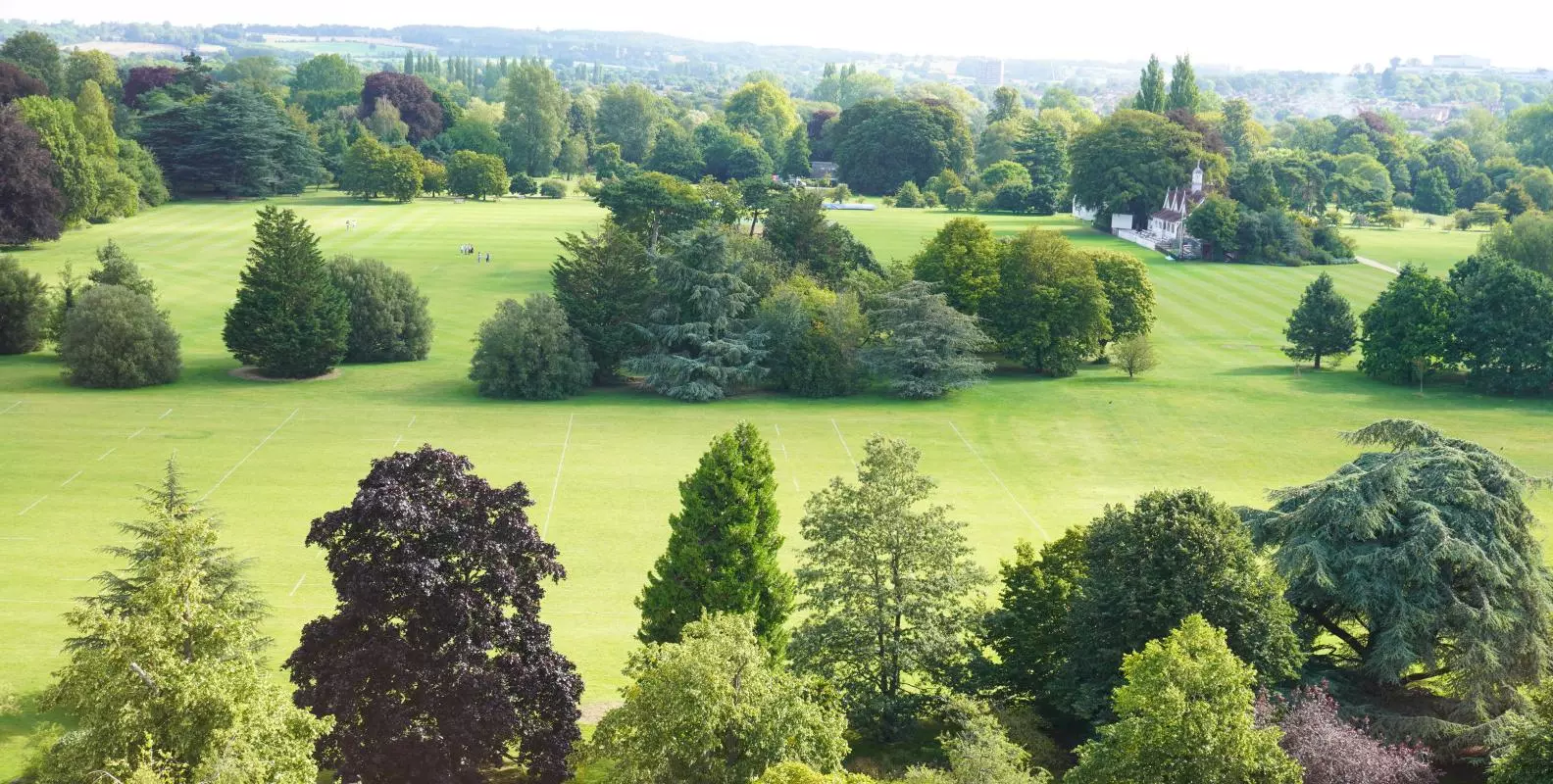
The University Parks aren't just a beautiful green space for everyone to enjoy - we also host a nationally important collection of trees.
This is a landscape created by botanists, and you'll find a wonderful diversity of trees. There are more than 1,900 trees from around 380 distinct taxa, from native British species like the 30+ varieties of hawthorn that line Thorn Walk to exotic specimens from every corner of the globe.
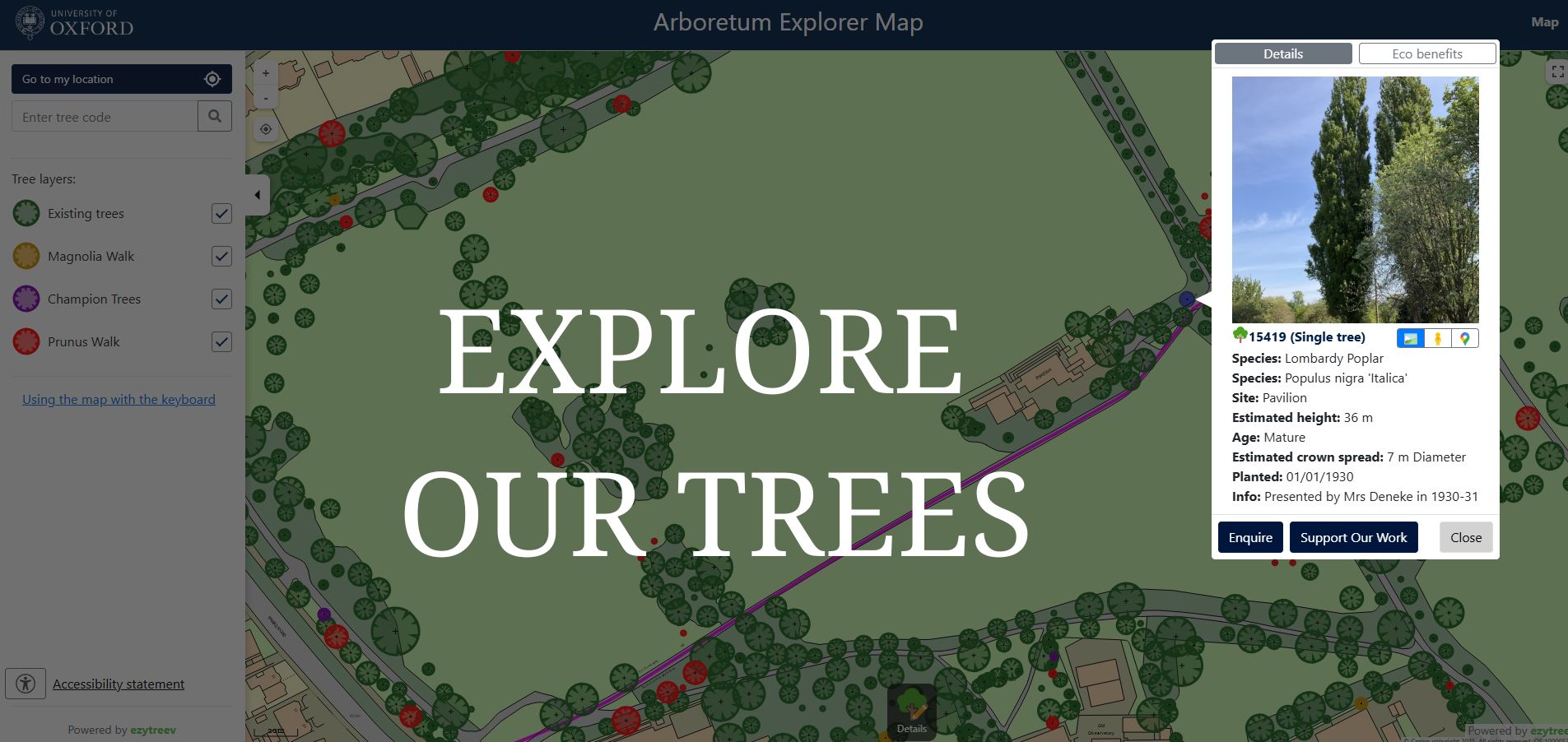
Discover our trees with Arboretum Explorer
Whether you are planning a visit from home or exploring the Parks in person, our interactive, mobile-friendly map covers all 1,900+ trees across the grounds. Use the map to:
- Locate & Identify: Tap any tree on-site to discover its species, age, condition, and size.
- Plan Your Route: Search by species or genus to design your own botanical walking trail.
- Track Environmental Benefits: Learn how our collection absorbs carbon, supports wildlife, and helps manage flooding.
Tip for your visit: Every featured tree listed on this page includes a unique ID code. To pinpoint a specific specimen on-site, simply type its code into the search box at the top left of the tree map.
Jump to a location or collection
Find out more about our highlight trees
North Walk | South Walk | Riverside Walk | West Walk | Lucas Walk | Central Parks | Commemorative Collections
Commemorative Collections
Coronation Clump
This ring of trees, consisting mainly of chestnuts and maples was planted to commemorate the coronation of Queen Elizabeth II in 1953. It also includes a Coulter's pine (Pinus coulteri), a native of the southwestern USA that produces the heaviest cones of any tree - up to 5kg each in its natural range.
Diamond Jubilee Trees
In 2013, the Curators of the University Parks invited each of the six Heads of Oxford University's Permanent Private Halls to plant a tree to commemorate the Diamond Jubilee of Her Majesty Queen Elizabeth II.
West Walk
Japanese Pagoda Tree (14302)
Styphnolobium japonicum, more commonly known as the Japanese pagoda tree, is native to China. This tree was planted in 1888 making it one of the oldest specimens in the Parks. In 1936 its girth was recorded as 6ft 6ins (1.98m), and in 2025 we measured it at 11ft 2ins (3.43m). It produces creamy yellow flowers in July which are the source of the transparent pigment Imperial Yellow.
South Walk
Tulip Tree and Bean Tree Avenue
The tulip tree (Liriodendron tulipifera) (8805) produces striking yellow-green, tulip-shaped flowers which open in June and July. It's a deciduous tree with striking yellow foliage, normally growing between 70 to 150 feet (21 to 46 metres), although the Parks' thin soil means the specimens here are unlikely to reach such heights.
The Indian bean tree (Catalpa bignonioides) (13380) has large heart-shaped deciduous leaves, showy, clustered flowers and long cigar-shaped fruit pods. Its white flower heads, splashed with orange and purple, appear in late summer. These are then followed by distinctive long black seed pods that remain throughout the winter.
Tetradium daniellii - Bee-bee tree (8791)
This fine tree, originally from Korea and China, produces 3-4mm scented white flowers in late summer. These are extremely popular with bees and butterflies, and are followed by dark red-purple fruit in autumn.
North Walk
Wellingtonias (8586)
The majority of the Parks' majestic cluster of Wellingtonia trees (Sequoiadendron giganteum), were planted in the late 1880s, with the smallest being added to the group in 1972. You can see them at the western end of the park, near North Lodge.
This species of tree is the world's largest living organism and includes some of the oldest living things on Earth. Based on ring count, the oldest known giant sequoia is 3,500 years old.
Heights of 300 feet and diameters of 30 feet are not uncommon in its native setting of North California. The Parks' thin soil means that most specimens of the trees here are unlikely to meet their full height potential.
Zelkova carpinifolia 'James Gordon' - Caucasian elm (15621)
This tree is the tallest of its type in the country at more than 33m. Zelkovas belong to the same family as the native elm - a close look at the leaves of both will show the family likeness. Almost all mature Caucasian elms in Europe are thought to have originated from the same nursery in East London in 1760.
Central Parks
Croquet Lawn
The Parks' croquet lawn is for the exclusive use of the Croquet Club and is surrounded by trees planted in 1878. These trees were designed to screen the Observatory which, when built in 1874, was isolated in the middle of the Parks. It is now part of the Science Area.
Disease-resistant elms (15372) - Picked Mead
This ring of seven trees planted in 2023 is made up of six different cultivated varieties that are resistant to Dutch elm disease and one closely related Japanese Zelkova (Z. serrata). Each of the elms has a different growth habit and represents the ingenuity of plant breeding. It is hoped that these trees will one day help support the rare white letter hairstreak butterfly (Satyrium w-album).
Elms were once an important part of Oxford's urban landscape before being wiped out by Dutch elm disease in the mid-20th century. We're helping bring them back now that breeders have created disease-resistant varieties - for example, we included several young elms in the row of street trees we planted along South Parks Road in 2024, where we hope they'll flourish for many years to come.
Lucas Walk
Fagus sylvatica f. Pendula - Weeping beech (10904)
First cultivated in 1836, this tree has wonderful cascading limbs that fall to the ground, layer themselves into the ground and go again, forming a soaring cathedral of drooping limbs to get lost in.
Riverside Walk and The Leys
Quercus coccinea - Scarlet oak (15909)
This tree was planted around 2015 having been originally introduced from Canada and the Eastern USA in 1691. Its flaming red autumn colour make it a spectacular seasonal attraction.