
In recent years regular users of North Walk in University Parks may have noticed the large fungi growing at the base of a beech tree surrounded by woodchip near Lady Margaret Hall gate. Over several years, the University Parks arboricultural team have been monitoring the size and distribution of this annually fruiting fungus called Giant Polypore (Meripilus giganteus).
During autumn, the fruiting body of this fungus; a soft and fleshy frond like mass, forms around the base of the tree and its main structural roots. This is then eaten by slugs or is destroyed by winter frosts.
Regularly associated with mature beech trees; the striking fruiting body is the reproductive part of a much larger unseen subterranean organism. The mycorrhizal network of the fungus allows it to act as a parasite of the tree, which is generally attributed as causing white and soft rot of the tree’s structural roots and eventually causes the tree to fail from the base.
Due to the method of decay of structural roots, the condition of the crown can appear reasonable with fine feeder roots remaining viable, but as the fungus progresses, gradual thinning of the crown can occur.
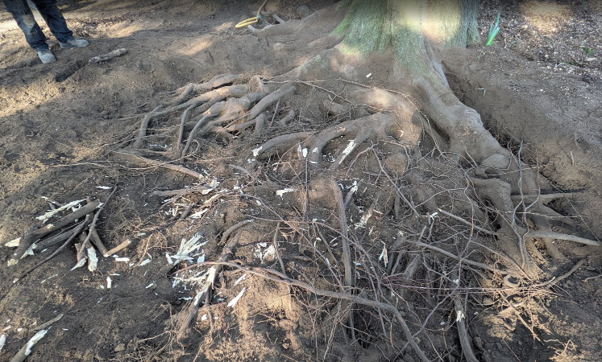
In March 2026 the arboricultural team, using an air spade, excavated around the rooting area of the tree exposing the root system to enable closer inspection. What they found was significantly decayed sections of the lateral roots that crumbled to the touch.
Exposed tree roots spread across a large area of bare soil around the base of a mature tree. Fine and structural roots are visible following excavation, with wood fragments scattered among the roots and gardening tools visible in the background.
Unfortunately, there is no known effective treatment of Giant Polypore. Since the first discovery of the fruiting body in 2020, the Parks team have attempted to improve its rooting environment through mulching, but the results of the air excavation have proved that this has been ineffective.
Due to its location close to the regularly used Thorn Walk, there is no option of management other than retrenching the crown and scaffold branches to reduce its sail area and leverage. The main trunk of the tree and some major scaffold branches will remain as a habitat feature with the woodchip retained and larger branches used for deadwood habitat throughout the park.
The Local Authority has been notified of the planned works, and we expect these to be undertaken towards the end of November 2026. Once removed we will plan to replant a replacement tree close by.
Contact us
- +44 (0) 1865 2 82040
- university.parks@admin.ox.ac.uk